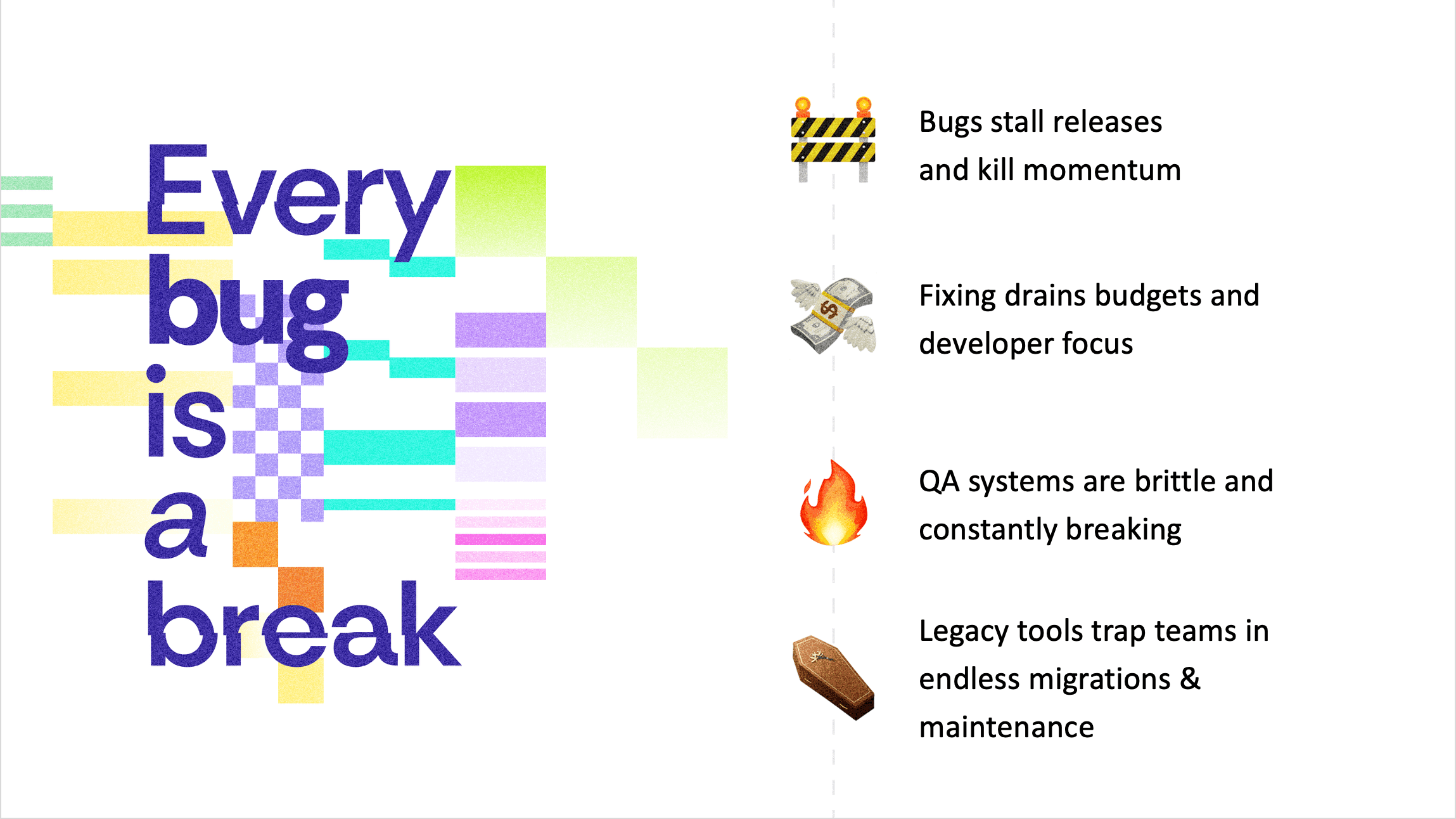
The QA bottleneck: every bug is a break
In today’s fast-paced software development landscape, every bug is more than just an inconvenience—it’s a break in momentum. For teams focused on delivering features swiftly, bugs represent a costly distraction. They derail release schedules, drain developer focus, and inflate operational budgets.
Legacy QA tools, such as Selenium and Cypress, while revolutionary in their time, now expose their limitations in this high-velocity environment. These frameworks rely heavily on brittle, script-based testing methods that require constant maintenance. A minor UI change can render entire test suites obsolete, forcing QA teams to spend valuable time fixing tests instead of identifying critical issues.
Furthermore, these systems often create QA debt—accumulated inefficiencies in testing processes that delay releases and force companies into reactive rather than proactive quality assurance. The result is a culture where QA struggles to match the pace of modern DevOps workflows, leaving developers and QA leads stuck in cycles of migration and maintenance instead of innovation.
The conclusion is clear: the bottleneck isn’t purely technical. It’s cultural. QA must evolve to meet today’s software velocity demands.
The shift: from manual QA to intelligent automation
The software testing industry is undergoing a seismic shift, driven by advancements in AI and automation. The rise of intelligent AI testing tools has made headlines in recent testing news and for good reason. Unlike traditional frameworks, these tools can learn from user behavior, adapt to real-world scenarios, and provide continuous feedback throughout the development lifecycle.
The “shift-left” movement, which emphasizes integrating QA earlier in the development process, has also gained momentum. By addressing bugs during the coding phase rather than post-release, teams can save significant time and resources. Continuous testing—an approach where automated tests run alongside development—further supports this by identifying issues in real-time.
While tools like Cypress enable powerful testing capabilities, they remain constrained by their reliance on human-defined scripts. This introduces maintenance overhead and limits scalability, especially for teams managing complex, ever-changing applications. On the other hand, AI automation eliminates these constraints by delivering scalable, self-healing solutions that adapt as software evolves.
It’s important to note that automation isn’t about replacing QA. Instead, it’s about making QA smarter, faster, and more efficient. By augmenting manual efforts with intelligent systems, QA can finally become continuous and proactive.
QA agents: AI that never sleeps
Enter QA agents, the next evolution in software testing. These AI-powered systems go beyond basic automation by simulating real user behavior and predicting how software will function in diverse scenarios. Unlike traditional methods, QA agents are designed to be adaptive, predictive, and autonomous.
One of the most transformative features of AI agents is their ability to perform self-healing tests. When an interface or logic change occurs, these agents automatically adjust their testing parameters without requiring manual intervention. This eliminates the brittle nature of script-based testing frameworks like Cypress, which frequently break under such conditions.
Additionally, QA agents operate 24/7, tirelessly identifying issues before they affect end-users. They excel at simulation testing and behavioral testing, replicating how actual users interact with applications to uncover hidden bugs. This proactive approach ensures that software is production-ready, reducing the need for post-release fixes that disrupt developer workflows.
As the industry moves toward predictive QA, AI agents stand out as the ultimate solution. They don’t just react to problems—they anticipate them, making testing both proactive and intelligent.
The future of quality: continuous, intelligent, invisible
Looking ahead, the future of software testing is poised to be continuous, intelligent, and, ultimately, invisible. AI agents will integrate seamlessly into every stage of development, operating quietly in the background to ensure performance, stability, and usability.
This evolution will have profound implications for software teams. Developers will spend less time fixing bugs and more time innovating. QA will shift from being a bottleneck to a catalyst for faster, more reliable releases. Automation will handle the repetitive, time-consuming aspects of testing, while human teams focus on strategic improvements.
Moreover, the concept of autonomous QA will redefine how we think about quality assurance. Instead of relying on scripts, AI-powered systems will deliver continuous verification and self-correcting mechanisms that adapt to changes instantly. This marks a fundamental shift from reactive to proactive QA, aligning with the needs of modern DevOps workflows.
As we enter this transformative decade for testing, one thing is certain: the future of QA won’t be built on scripts. It will be driven by intelligence, scalability, and innovation. From Cypress to self-learning AI agents, software testing is evolving to meet the challenges of tomorrow’s digital landscape.